
How a concussion substitute became the world’s No. 1 Test batter and how skill, fortune, adaptation and regression pulled his career in opposite directions.
The verdict before the argument
Let’s call it early: Marnus Labuschagne was not a statistical fraud. He was a genuinely high-class Test batter whose best years were supercharged by an extraordinary, measurable run of fortune. When that fortune normalised, it exposed and then amplified, technical and strategic weaknesses already creeping into his game.
The strongest public evidence does not quite prove that he was “the luckiest batsman of all time”. Cricket does not possess a complete, standardised chance database for all eras, and even the modern record depends on subjective classifications. It does, however, support a striking and narrower claim: during the first phase of Labuschagne’s rise, no Test batter had been dropped or missed more often since his debut, and nobody gained more runs from those reprieves. His record was not invented by luck. It was materially inflated by it.
That is the curious case. Labuschagne’s story is neither the triumphalist yarn- obsessive apprentice turns himself into a genius; nor the cheap sledge- ordinary batter exposed when the catches finally stuck. Both are too neat. The player was real. The improvement was real. The luck was real. And the decline is more than luck running out.
1. Before the meteoric rise
Labuschagne did not arrive with the statistical halo of a prodigy. When Australia first selected him in 2018, his Sheffield Shield average was below 35 and he had four first-class hundreds from more than 60 innings. He was 24, neither a teen phenomenon nor a late-career domestic colossus. In the post-Cape Town disarray, Australia were searching as much as selecting.
His first Test innings, in Dubai, produced an eight-ball duck. His first four Tests produced useful fragments rather than inevitability: leg-spin wickets, sharp fielding, a 38 against India, then 81 against Sri Lanka. There was enough strangeness and appetite to remain interested, but nothing in the base rate foretold what came next.
Then, at Lord’s in August 2019, Steve Smith was struck by Jofra Archer. Labuschagne became Test cricket’s first concussion substitute and walked into the middle during one of the most violent spells of the modern era. Archer hit him too. Labuschagne got up, made 59, and did something selection systems love: he converted emergency into evidence.
2. The ascent: from spare part to No. 1
The rise was not merely fast; it was geologically absurd. Across 2019 he scored 1,104 Test runs at 64.94 and finished as the year’s leading Test run-scorer. After the Ashes came 185 and 162 against Pakistan, then 143, 50, 63 and 19 against New Zealand. Between 2019 and 2021, Cricket Australia’s later summary credits him with a Test average of 72.82, five hundreds and nine fifties in 13 matches. On 22 December 2021, the ICC made it official: Labuschagne was the No. 1 Test batter in the world. His career average later peaked around 62. By 23 August 2026, after 65 Tests, it stood at 43.79: 4,730 runs from 117 innings, with 11 hundreds.
| Phase | Record | What it says | Caveat |
| Pre-breakthrough | Shield average below 35 at first selection | An informed punt, not a generational statistical case | Domestic averages do not capture role, age curve or development |
| 2019 | 1,104 runs at 64.94 | Immediate elite Test production | Included several substantial reprieves |
| 2019 – 2021 Peak | Average 72.82; 5 hundreds, 9 fifties in 13 Tests | A sustained world-class output, not one hot series | Home-heavy schedule and exceptional catch survival |
| After 2023 Ashes | About 26 per dismissal across 40+ innings | The slump is long enough to be structural | Conditions, role changes and selection churn matter |
The art inside the numbers
There was a batting idea here, not just a scorecard accident. Labuschagne borrowed Smith’s exaggerated leave and restless mannerisms, but beneath the theatre was a more orthodox machine. He got forward, defended late, wore bowlers down and punished the full ball through cover. He was unusually strong against the good-length delivery — the ball that defines Test batting because it offers neither an obvious drive nor an easy leave.
At his peak, CricViz calculated that he averaged above 70 against good-length pace. Between 2019 and 2022, he played 132 defensive strokes for every dismissal caused by one; only Kane Williamson was better. He was also excellent at turning edges into survival: CricViz found that he edged 22 balls for every dismissal from an edge, the best rate in the world from the start of 2018 at the time of its analysis.
Some of that is batting craft. Soft hands reduce carry. Playing late changes angles. A batter who gets set can force captains to remove slips, making later edges safer. A good leave reduces the population of edges in the first place. Luck is not the opposite of skill; often it is the unowned residue left after skill has shifted the probabilities.
3. The luck audit
To discuss luck seriously, we need to stop treating every “play and miss” as a wicket stolen from a bowler. A false shot is risk, not a dismissal. A thick edge through a vacant third slip may be tactical consequence, captaincy error, soft hands or random placement. A regulation catch put down is much closer to pure reprieve. An umpiring decision is different again because DRS can correct some errors but not all of them.
The hard evidence: 16 reprieves and 567 runs
ESPNcricinfo’s January 2022 audit considered dropped catches and missed stumpings from Labuschagne’s debut in October 2018. It excluded “half-chances” and retained regulation and tough chances. The result was extraordinary: Labuschagne had been reprieved 16 times and caught or stumped 25 times. Only 61 per cent of the 41 recorded chances he offered were completed; 39 per cent were missed.
The normal context matters. CricViz, using its own classification, found that only 58 per cent of Labuschagne’s chances had been taken. The Test-wide completion rate was just above 80 per cent; for other batters in the same matches it was 72 per cent. Different providers, slightly different definitions, same conclusion: Labuschagne was an extreme outlier.
The 16 misses were the most suffered by any batter in Tests over that period. That is the headline. Now for the bit that stops the headline becoming nonsense. Among batters who offered at least 20 chances in ESPNcricinfo’s sample, Mushfiqur Rahim had a still higher reprieve percentage: 45.45 per cent, compared with Labuschagne’s 39 per cent. Labuschagne was the volume leader, not the rate leader.
Where he was emphatically No. 1 was the cashing-in. He scored 567 of his first 2,220 Test runs after reprieves in nine innings- 25.54 per cent of his total. ESPNcricinfo’s deliberately simplified counterfactual removed those post-reprieve runs and reduced his average from 56.9 to 42.4, with three fewer hundreds and four fewer fifties. No batter in the period gained more runs in absolute terms after being let off.
| Until January 2022 | Labuschagne |
| Recorded catch/stumping chances offered | 41 |
| Dismissals completed | 25 |
| Reprieves | 16 |
| Reprieve rate | 39% |
| Runs scored after reprieves | 567 of 2,220 (25.54%) |
| Simplified no-reprieve average | 42.4 rather than 56.9 |
| Milestones affected in that model | 3 fewer hundreds; 4 fewer fifties |
The innings that made the pattern visible
At Headingley in 2019, Labuschagne was reprieved three times on the way to 80. At Adelaide in 2021, he was dropped at least three times on the way to 103- four if a very difficult Ben Stokes chance is included. ESPNcricinfo identified two further innings in which he was reprieved twice. These were not harmless drops after the work was already done. They occurred inside innings that built his average, milestones and aura.
Yet the phrase “made the most of his luck” is not a consolation cliché. Many batters are dropped and then dismissed soon afterwards. Labuschagne repeatedly reset. The fielding side had failed once; he made it fail for hours. Fortune supplied additional life, but concentration converted life into record.
4. Luck didn’t create him. But it changed the size of him.
The easiest mistake now is to swing too far.
If Labuschagne was extraordinarily lucky, was the whole thing a statistical mirage?
No.
CricViz estimated that if catches had been completed at a more normal rate during his great 2019-to-2021/22 run, his average would have been just under 50 rather than 64.17. That distinction matters. An average around 50 is the record of an outstanding Test batter. Luck appears to have pushed a very good player into statistically extraordinary territory; it did not manufacture a Test cricketer from spare parts.
And his subsequent decline cannot be explained simply by saying the catches started sticking.
His false-shot percentage barely moved at first- from roughly 15 per cent in the two years before 2023 to 16 per cent from the beginning of 2023 to late 2024. But the consequences of those mistakes changed dramatically. At his peak, Labuschagne averaged above 70 against good-length pace. From the start of 2023 to CricViz’s December 2024 analysis, that figure had collapsed to 14. His defensive survival against pace deteriorated from one dismissal every 132 defensive strokes in 2019–22 to one every 53 from 2023.
The method was changing too.
He began leaving more deliveries, but his judgement outside off became less precise. His average leave moved almost a foot wider than during his peak. The cover drive became rarer. His front-foot presence diminished. Bowlers increasingly attacked him from wider positions and made the channel outside off stump do the work.
Then came another complication: Labuschagne’s obsessive appetite for improvement.
In August 2026 he described years spent pursuing “short-term solutions” involving his grip, stance and other technical details. The trait that helped build him may eventually have started working against him. Instead of one stable method being refined, the method accumulated repairs.
That is a far more interesting explanation than karma.
The catches did start sticking. But the batter waiting underneath them was no longer quite the same one.
5. So, how good was Marnus Labuschagne?
By August 2026, the contrast had become brutal.
His last Test hundred had come at Old Trafford in July 2023. Before the Mackay Test three years later, he had made 937 runs in 40 innings at 26.03. He had already been dropped once, returned after four first-class hundreds in five matches, and still hadn’t rediscovered the production of his peak.
Then in Mackay he made four.
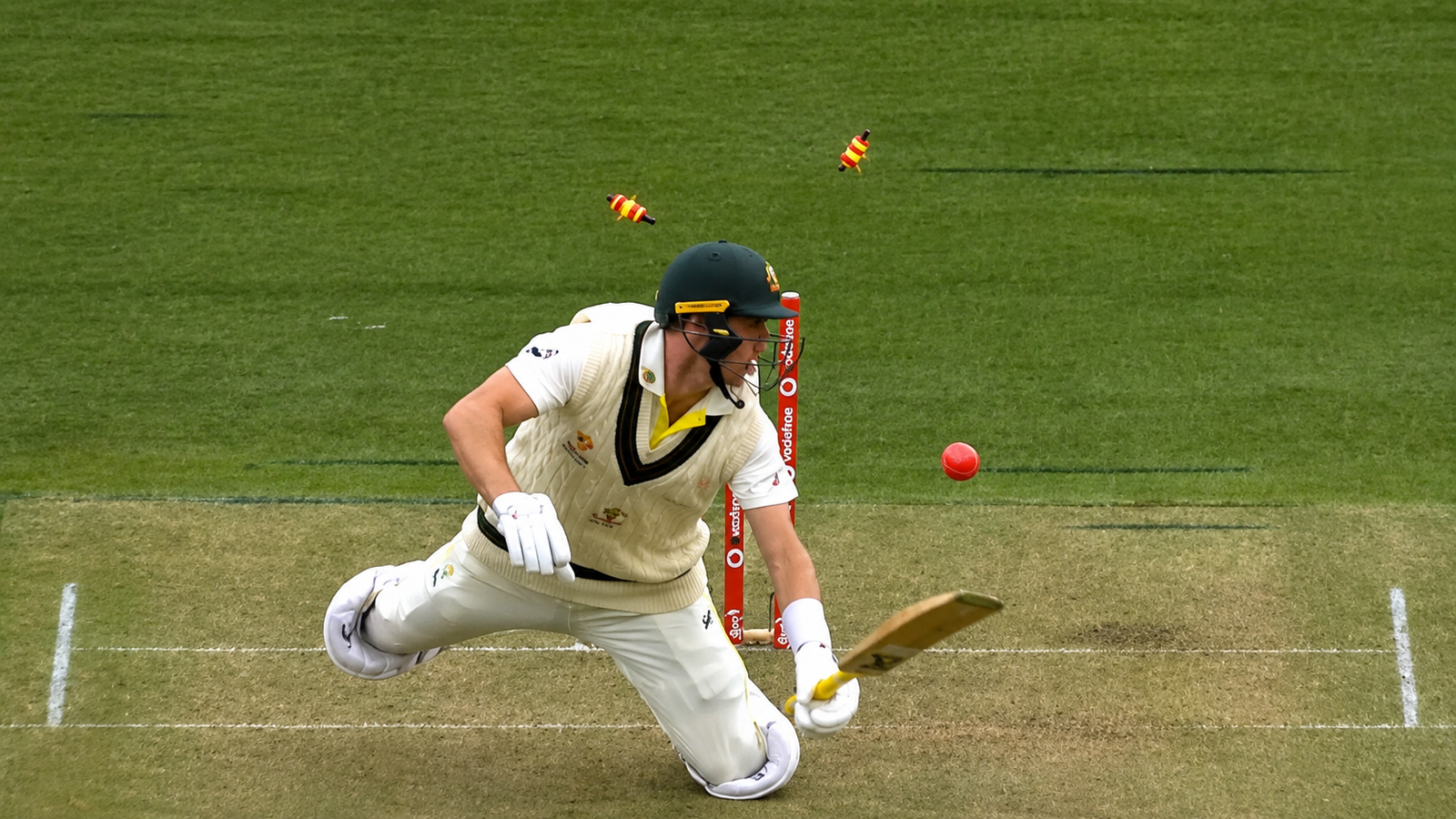
The dismissal was almost too neat for the story: the ball struck the underside of his thigh pad, changed direction and knocked a bail from the stumps. For years, catches had gone down and edges had found grass. Now a ball that could easily have disappeared harmlessly towards fine leg found timber instead.
There is a temptation to make that cricket’s idea of justice.
Don’t.
Probability has no memory. Labuschagne was not owed that dismissal because somebody dropped him at Headingley seven years earlier.
The proper judgment is less theatrical and considerably more interesting.
Marnus Labuschagne built a world-class batting method and then received an abnormal number of opportunities to keep demonstrating it. Luck magnified the rise; it did not create the player. When that luck normalised, technical drift, opposition adjustment and perhaps his own relentless tinkering magnified the fall.
That leaves us with two equally lazy arguments to reject.
Calling him a fraud ignores the skill required to become the world’s No. 1 Test batter, even with fortune at his back. Saying everyone gets dropped ignores just how abnormal his recorded run of reprieves actually was: 16 reprieves from 41 recorded catching or stumping chances, with 567 runs subsequently accumulated after those escapes.
Was he the luckiest Test batter of all time?
We cannot know. The historical data simply isn’t good enough to make that claim responsibly.
But was this one of the most statistically extreme and consequential runs of catching fortune we can document in modern Test cricket?
Yes.
And perhaps that is what makes the curious case of Marnus Labuschagne worth remembering. Not that luck made him great, nor that its disappearance exposed him as ordinary.
He was a very good batter whose numbers briefly became immortal.
That is stranger and better than either myth.
Leave a Reply