
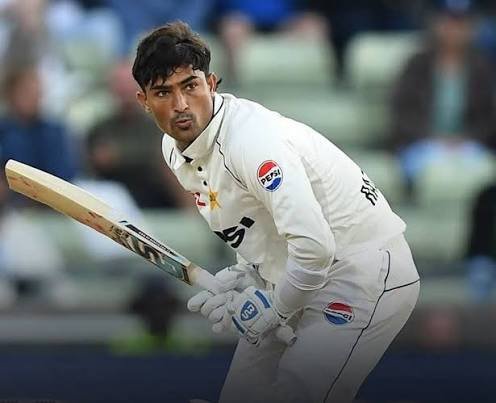
Fourth ball in Test cricket- claimss Joe Root’s wicket. Four wickets, scors 81 with nine sixes for good measure. Razaullah Mashwani Khan is 21, gloriously raw and very, very Pakistani.
Pakistan cricket has many problems. Producing cricketers has never really been one of them.
Every few years, usually when the administration appears busy setting fire to another part of the furniture, somebody emerges from the ashes. A fast bowler. A wrist-spinner. A batter nobody outside domestic cricket had heard of six months earlier.
This time his name is Razaullah Mashwani Khan.
Twenty-one years old. Eight first-class matches before his Test debut. A fast bowler from Khyber Pakhtunkhwa who grew up playing tape-ball cricket in Mardan.
Then somebody gave him a Test cap at Edgbaston.
Four wickets.
Joe Root with his fourth ball in Test cricket.
Then 81 from 63 balls at No. 9.
Nine sixes.
Because apparently simply having a good debut would have been far too conventional.
From Mardan to Edgbaston
Razaullah was born in the Upper Dir region of Khyber Pakhtunkhwa in April 2005 before his family moved to Mardan when he was very young. His cricket began in the wonderfully unpolished ecosystem that has supplied Pakistan with players for generations: tape-ball cricket, local grounds and eventually academy and district competition.
His organised rise was remarkably quick.
He progressed through Mardan Under-19 cricket and the Abbottabad regional system before playing for Sahir Associates. By the 2025–26 domestic season there was considerably more than raw pace to notice. He took 30 wickets in five President’s Trophy matches, while his first-class batting had already produced a century.
The PSL followed with Rawalpindiz in 2026. Aaqib Javed noticed him at the National Cricket Academy. Then came a fast-bowling camp.
Then England.
Pakistan arrived at Edgbaston 2–0 down in the series and in considerable disarray. Seven players had been released after Lord’s. The coaching staff had changed. The batting had spent much of the tour behaving as though 200 were an optional stretch target.
Into this walked a 21-year-old with eight first-class games behind him.
Hello, Joe!
There are easier ways to introduce yourself to Test cricket than bowling to Joe Root in England.
Razaullah chose the other way.
His fourth delivery in Test cricket dismissed Root lbw.
Not a tailender. Not a nervous debutant. Joe Root.
The speed mattered too. Razaullah was operating around 90mph- roughly 145km/h. With bounce and an action unfamiliar enough to make batters solve him in real time. He eventually finished with 4 for 148 from 23 overs as England made 453. The economy rate was ugly. The raw materials were anything but.
That distinction matters.
Four for 148 is not evidence that Pakistan have discovered the finished article. It is evidence that they have discovered something worth finishing.
And then he picked up a bat.
Pakistan had conceded a first-innings deficit of 320.
In the second innings they finally showed some resistance, but when Razaullah arrived at No. 9 they were 312 for seven and still eight runs short of making England bat again.
A sensible debutant fast bowler might have nudged a few singles.
Razaullah decided to attack England.
He reached fifty from 43 balls. He went after Gus Atkinson. He went after Josh Tongue. And, most gloriously, he went after Jofra Archer’s pace rather than merely trying to survive it.
His explanation afterwards was almost disappointingly simple.
“He wasn’t scared of pace.” That was fairly obvious.
Razaullah finished with 81 from 63 balls, four fours and nine sixes. Those nine sixes equalled the record for the most in a Test innings by a debutant. With Mohammad Abbas he added 121 for the ninth wicket, dragging Pakistan from the edge of an innings defeat to 449 and forcing England to chase 130.
Edgbaston gave him a standing ovation. Quite right too.
Pakistan ultimately lost the Test and the series 3–0. We should not turn one spectacular afternoon into a resurrection story. Razaullah remains a young fast bowler with almost no first-class mileage, an expensive first Test bowling analysis and plenty of technical development ahead.
But that almost makes the story better.
Because Pakistan didn’t unveil a polished international cricketer at Edgbaston.
They unveiled possibility.
Pakistan’s Ridiculous Talent Factory
This is the maddening thing about Pakistan cricket.
The system can look dysfunctional and the production line somehow keeps moving.
Other cricket nations build pathways. Pakistan occasionally seems to discover somebody bowling frighteningly quickly in Mardan and asks whether he has a passport.
In Razaullah’s case, reports suggest he didn’t have one when the call-up came.
That is funny. It is also revealing.
Pakistan’s great cricketing advantage has always been the enormous informal game beneath the official one: tape-ball cricket, club cricket, district competitions, departmental teams, academies and local tournaments. Talent develops outside pristine pathways because cricket is embedded deeply enough for players to emerge anyway.
That chaos has produced some extraordinary cricketers.
But we should resist romanticising it.
Finding talent despite an imperfect system is not evidence that the system works.
Razaullah is now the PCB’s responsibility.
The temptation will be obvious. He bowls 145km/h. He hits enormous sixes. He has personality. He has already produced the sort of debut that creates highlight reels before a player has learned where the team bus parks.
So Pakistan must do something it has not always done particularly well with exciting young fast bowlers.
Leave some meat on the bone.
Build his body. Manage his workload. Let him play first-class cricket. Improve his control without coaching the menace out of him. Develop the batting because there is clearly something there. And resist turning a 21-year-old prospect into the answer to every national crisis before he has played ten Tests.
Because Edgbaston did not tell us what Razaullah Mashwani Khan will become.
It told us why we should want to find out.
A kid who began with tape-ball cricket in Mardan walked into Test cricket in Birmingham, removed Joe Root with his fourth ball, took four wickets, then stood at No. 9 and launched nine sixes into an English afternoon.
Pakistan lost the match. Pakistan lost the series.
And somehow, amid all that wreckage, they found another fast bowler.
Of course they did!
Leave a Reply