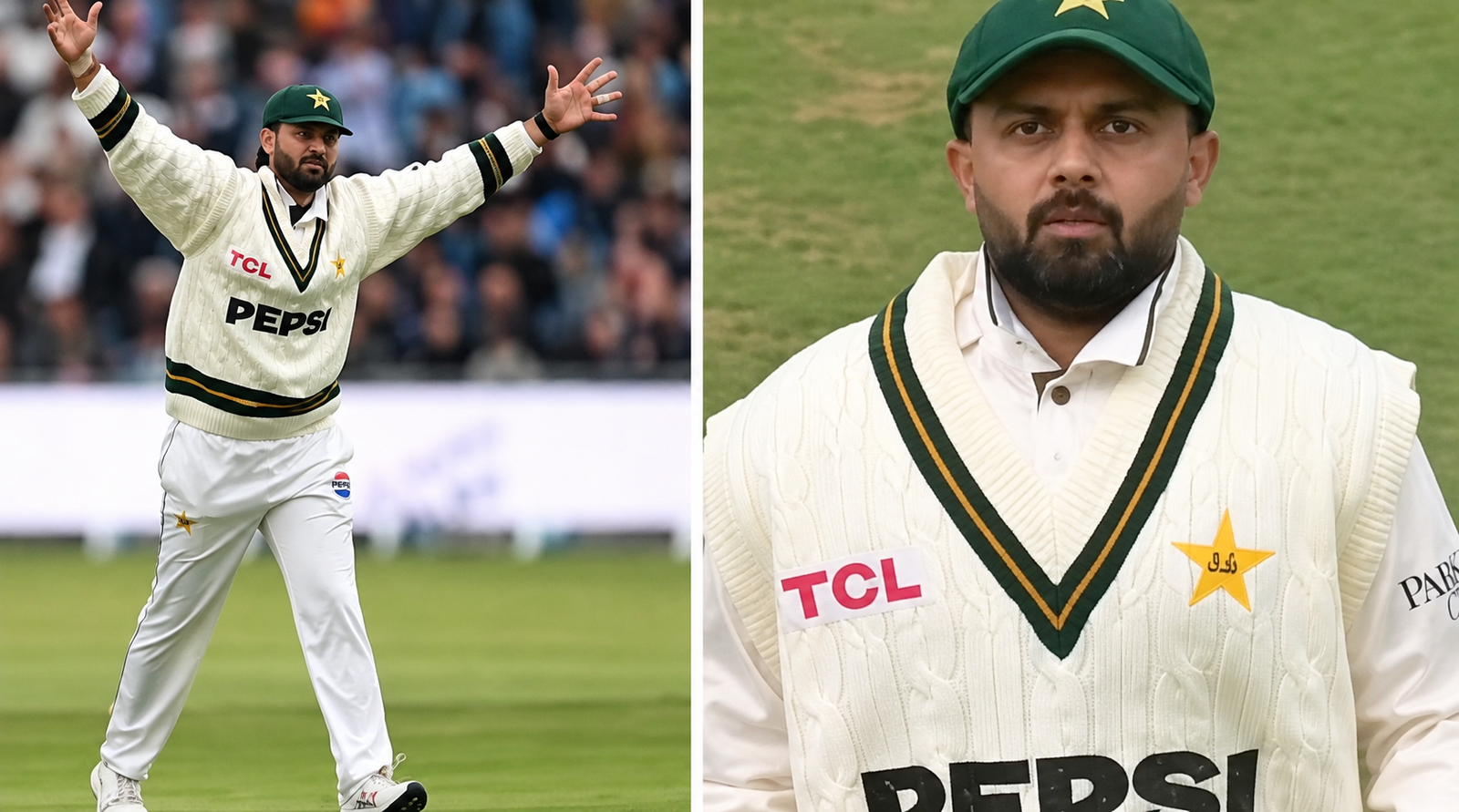
The sweaters were too big. The fielding was too loose. The defeat was enormous. But somewhere inside Pakistan’s Headingley comedy was something rather less funny.
There are bad days in Test cricket.
There are days when you nick the good balls, drop the difficult catches and discover that the opposition has apparently been practising while you have spent the previous fortnight walking under ladders.
And then there are days when your captain tries to run out an England batter and hits his own wicketkeeper instead.
Pakistan had one of those Tests at Headingley.
They lost to England by an innings and 103 runs inside three days. They were bowled out for 171 and 135. England made 409. Ollie Robinson and Josh Tongue took eight wickets each across the match.
That should have been the story. Somehow, it wasn’t even the funniest part.
Because Pakistan arrived at Headingley wearing Test sweaters so gloriously oversized that the cricket internet briefly forgot there was a cricket match going on.
And then they started fielding.
The Sweater
There is something beautiful about a proper Test cricket sweater.
Cream wool. Cable knit. Coloured trim around the neck. Sleeves pulled over the forearms on a cold English morning.
It belongs to Test cricket in the same way the baggy green, the Lord’s pavilion and an unnecessarily detailed discussion about cloud cover belong to Test cricket.
Pakistan got the first part right. They definitely brought sweaters.
The problem was that several appeared to have been ordered for considerably larger Pakistan cricketers.
The sleeves hung. The waists billowed. Salman Ali Agha looked less like the captain of an international cricket team and more like a teenager whose mother had deliberately bought his school jumper two sizes too large because you’ll grow into it.
The internet noticed immediately.
One joke suggested only XXL and XXXL had survived some sort of clearance sale. Another offered perhaps the most culturally devastating explanation possible: Mum bought it big so it would last another couple of years.
Brutal. Also, objectively, very funny.
And none of this should matter.
Professional sport has developed a strange obsession with presentation. Matching tracksuits. Branded luggage. Haircuts sharp enough to take wickets.
Cricket is played with bat and ball, not tailoring.
If Pakistan had caught everything and bowled England out for 180, those sweaters would already be cult classics.
Instead, the clothes became part of the metaphor.
Everything looked a little loose. And then the cricket did too.
And Then They Started Fielding
This is where the comedy stopped being cosmetic.
Pakistan had opportunities at Headingley. They simply kept finding inventive ways not to take them.
Harry Brook was given a life and went on to make 91. There were dropped chances, misfields and missed opportunities as England reached 366 for eight by the end of the second day and took control of the Test.
Then came the masterpiece.
Dan Lawrence charged down the pitch, missed a full toss and was struck on the pad. Pakistan appealed.
Lawrence, meanwhile, was stranded outside his crease.
This was not a subtle run-out opportunity requiring Ricky Ponting to swoop from cover, collect one-handed and throw down a single stump while travelling horizontally.
The batsman was simply out of his ground.
Eventually Salman Ali Agha noticed. He picked up the ball.
He threw at the stumps. And hit Mohammad Rizwan.
Lawrence survived.
There is cricket analysis one can perform here.
Decision-making. Situational awareness. Communication. Fielding mechanics.
But occasionally cricket produces something so perfectly constructed that analysis feels disrespectful.
You simply admire the work.
Pakistan weren’t finished.
Ali Usman later attempted to stop a boundary with his feet, the ball escaped him, and another clip was released into the social-media ecosystem where Pakistan fielding mistakes have historically enjoyed unusually fertile soil.
By this point, Headingley had stopped looking entirely like an international Test match.
It had begun resembling the final half-hour of club cricket when everyone is cold, somebody has lost the scorebook and the bloke fielding at deep square has mentally moved on to the pub.
Except these were international cricketers.
And that distinction matters.
Pakistan Cricket Has Always Been Funny — Until It Isn’t
There is a temptation here, particularly outside Pakistan, to reach for the oldest cliché in cricket.
Classic Pakistan. Unpredictable. Chaotic.
Brilliant one minute, ridiculous the next.
It is an extraordinarily durable stereotype because Pakistan cricket has supplied enough evidence over several generations to keep feeding it.
And there is affection inside it.
Few cricket nations have produced such an improbable collection of fast bowlers, wristy batters, mystery spinners, reverse swing, spontaneous genius and completely inexplicable cricket.
Pakistan have often made the game feel less manufactured.
That is part of their charm.
But there is a point at which unpredictability stops being romantic.
A dropped catch isn’t flair. A basic misfield isn’t improvisation.
A confused run-out isn’t the mystical nature of Pakistan cricket.
It is bad cricket. And Pakistan played too much of it at Headingley.
England were good enough that they didn’t need assistance. Pakistan provided it anyway.
That is the distinction worth making because otherwise the jokes become an excuse.
Call the sweaters funny.
Replay Salman hitting Rizwan.
Enjoy the memes.
I certainly did.
But don’t confuse comedy with explanation.
Pakistan didn’t lose because their sweaters were too large.
They lost because England were substantially better at the fundamental acts that decide Test matches.
Batting for long enough. Bowling accurately enough.
Taking chances. Making fewer mistakes.
The scorecard eventually stripped away the comedy: 171, 409, 135.
England by an innings and 103 runs.
That isn’t a meme. That’s a hiding.
Keep the Sweaters
Here is the strange part.
I don’t want Pakistan to become sterile.
International cricket already has enough performance departments, matching training kits, media-trained captains and players saying they are going to take the positives after losing by an innings.
Pakistan’s capacity for chaos is genuinely part of cricket’s texture.
And the oversized sweaters?
Keep them. Absolutely keep them.
Test cricket could use more things that look as though they were designed in 1987.
Just catch the bloody ball.
Because there is a version of Pakistan cricket where the sweater becomes magnificent.
Salman takes the catch. Rizwan completes the run-out. Pakistan bowl England out cheaply. Someone scores a hundred in a jumper with enough spare material to house the entire slip cordon.
Then it isn’t embarrassing. It becomes iconic.
That’s the wonderful cruelty of cricket.
The difference between comedy and character is often just the scoreboard.
Leave a Reply